
How to Get Your Website Featured in Google AI Overviews

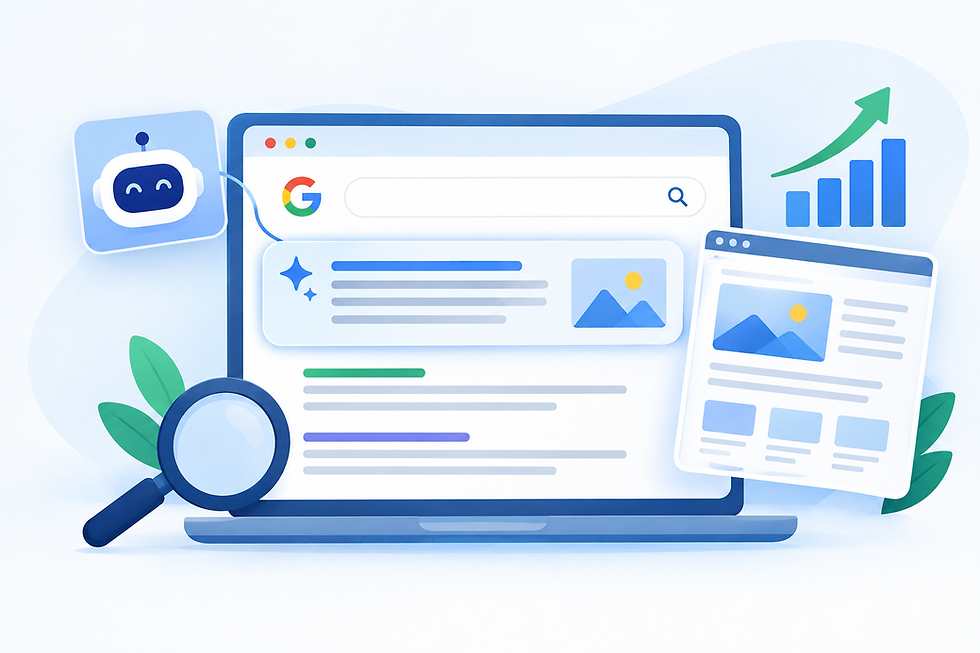
Google AI Overviews are changing how people search for information online. Instead of displaying only traditional website links, Google can generate AI-powered summaries that answer users' questions directly on the search results page. These summaries may include links to relevant sources that help users explore a topic in greater detail.
For businesses, appearing in these summaries can create additional opportunities to build brand awareness, establish credibility, and attract relevant website visitors. However, getting featured in Google AI Overviews is not as simple as adding keywords to a webpage. Websites need helpful content, strong technical foundations, clear information, and trustworthy signals.
Understanding how AI-powered search works can help businesses improve their visibility and create content that serves both users and search engines.
What Are Google AI Overviews?
Google AI Overviews are AI-generated summaries displayed for certain search queries. They combine information from multiple sources to provide users with a quick understanding of a topic. Depending on the query, these summaries may include links to websites that support or expand on the information presented.
For example, someone searching for website development tips, digital marketing strategies, or local business recommendations may see an AI-generated summary alongside links to relevant resources.
Unlike traditional search results, where rankings are primarily presented as a list of webpages, AI Overviews can highlight sources that are useful for answering specific questions. This means businesses should focus not only on ranking for keywords but also on providing accurate, relevant, and well-organized information.
Being included is not guaranteed, and Google does not offer a special optimization method that ensures a website will appear in every AI Overview.
Create Helpful, Original, and Relevant Content
High-quality content is an important foundation for improving visibility in AI-powered search results. Your webpages should answer genuine user questions rather than simply repeat popular search terms.
Start by identifying the problems your audience wants to solve. If your business provides digital marketing services, your audience might want to understand how SEO works, how to improve website traffic, or how to generate qualified leads.
Develop detailed articles that address these questions with practical explanations, relevant examples, and actionable recommendations. Avoid generic statements that could appear on any website. Original insights, real business experience, and clearly explained processes can make your content
more valuable.
Organize each article around a specific topic. Introduce the main question early, explain the key concepts, and provide supporting details in a logical order. This structure helps readers find answers quickly and makes the content easier for search systems to interpret.
Answer Search Queries Directly
Many users search through questions, such as “How can I improve my website ranking?” or “What makes a website user-friendly?” Creating content that directly addresses these queries can improve its usefulness.
Include clear answers near the beginning of relevant sections, followed by additional context and examples. For instance, an article about website performance could explain that page speed, mobile usability, efficient code, and optimized images all contribute to a better user experience.
Use descriptive headings that reflect the questions your audience is asking. Supporting sections can address related concerns, explain common mistakes, and offer practical solutions.
However, avoid creating numerous pages that answer nearly identical questions with little original value. A comprehensive, well-maintained resource is often more useful than multiple repetitive articles created solely to target search variations.
Follow Strong SEO Fundamentals
Traditional SEO remains important for websites seeking visibility in Google AI Overviews. Google's AI features rely on its search systems, and there is no separate technical checklist that guarantees inclusion.
Start with relevant keyword research to understand the language your audience uses. Place primary keywords naturally in page titles, headings, introductions, and body content where appropriate. Avoid keyword stuffing, which can make content difficult to read.
Use descriptive title tags and meta descriptions that accurately communicate each page's purpose. Add meaningful internal links to connect related articles and service pages, helping users navigate your website and helping search engines understand relationships between topics.
External links from relevant, reputable websites can also help people discover your content and support your site's broader reputation. Focus on earning genuine editorial mentions rather than buying links or using manipulative link-building schemes.
Regularly review existing pages to update outdated information, improve clarity, and remove unnecessary repetition.
Improve Website Design and User Experience
Your website's design influences how visitors interact with your content. A confusing layout, difficult navigation, or slow-loading page can prevent users from finding the information they need.
A professional website should have a logical structure, readable typography, clear navigation, and responsive layouts that work across mobile phones, tablets, and desktops. Important information should be easy to locate without excessive scrolling or intrusive pop-ups.
Businesses planning to improve their online presence can work with a website design company in Vizag to build a technically sound, user-friendly website that supports content discovery and organic search performance.
Good design alone will not secure an AI Overview citation. However, combining usability with useful content, accessible page structures, and reliable technical SEO creates a stronger foundation for search visibility.
Demonstrate Experience, Expertise, and Trustworthiness
Search engines aim to provide useful and reliable information. Your website should therefore make it clear who created the content, why the information is credible, and how the business has relevant experience.
Publish accurate author biographies where appropriate, maintain a detailed
About Us page, and provide clear business contact information. For professional or technical topics, reference reliable sources and explain important claims
rather than presenting unsupported statements as facts.
Businesses can strengthen credibility by publishing original case studies, practical examples, customer experiences shared with permission, and transparent explanations of their services.
Keep your business details consistent across your website and legitimate business listings. Ensure that claims about qualifications, achievements, and customer results are accurate and verifiable.
Trust is not established by a single badge or a particular phrase. It develops through consistent, useful information and a website that gives visitors good reasons to rely on it.
Use Structured Data Correctly
Structured data helps search engines interpret specific information about a webpage or business. Depending on the content, relevant schema types may include Organization, LocalBusiness, Article, BreadcrumbList, and other supported types.
For example, appropriate Organization or LocalBusiness markup can help describe a business's identity and contact details. Article markup can clarify information such as the headline, author, and publication date.
Implement structured data only when it accurately reflects the visible content on your page. Validate the markup using Google's supported testing tools and correct any errors.
It is important to understand that structured data does not guarantee inclusion in AI Overviews. Its primary purpose is to provide clearer, machine-readable context and support eligible search features.
Make Your Website Easy to Crawl and Index
Search engines must be able to access and process your content before it can become a potential source for search results.
Check that important pages are not accidentally blocked by robots.txt rules or restrictive indexing directives. Submit an XML sitemap through Google Search Console and inspect key URLs to confirm whether Google can access and index them.
Pay attention to broken links, redirect chains, duplicate pages, canonical tags, and mobile usability. Ensure that essential content is available in a format search engines can reliably process.
Monitor your website's indexing status and organic search performance
regularly. If a page is not indexed, investigate the cause rather than assuming that publishing it automatically makes it eligible for search visibility.
Build Topic Authority Through Relevant Content
Publishing consistently about a focused subject can help demonstrate the depth and relevance of your website's resources. Instead of covering unrelated topics, develop a content strategy around the services, products, and questions most important to your audience.
For example, a digital marketing website might publish a central SEO guide supported by articles on keyword research, technical SEO, local search, content optimization, and website performance. Internal links can connect these resources and direct readers to relevant service pages.
Leadraft can use this content-led approach to help businesses strengthen their digital presence through useful resources, website optimization, and search-focused strategies.
Measure success through several indicators, including organic impressions, relevant clicks, qualified leads, engagement, and brand visibility. AI Overview appearances can fluctuate, so evaluate your broader search performance rather than relying on a single placement.
Track Results and Keep Improving
Google Search Console is useful for monitoring impressions, clicks, click-
through rates, and search queries associated with your website. Compare performance over time and identify pages that receive impressions but attract
few visits.
Review whether your content answers the intended query, whether the page title accurately represents the information, and whether the page provides enough depth to satisfy readers. Update content when facts, tools, or industry practices change.
You can also manually review relevant search queries to see whether AI Overviews appear and which sources are cited. Because AI-generated results can vary by query, location, device, and time, treat these observations as directional rather than complete performance measurements.
The most sustainable strategy is to create content that deserves to be referenced: accurate, useful, well-structured, technically accessible, and supported by credible business practices.
Getting your website featured in Google AI Overviews requires a long-term approach to content quality, technical SEO, user experience, and credibility. No technique can guarantee a citation, but answering user questions clearly, strengthening topic coverage, improving website accessibility, and maintaining trustworthy information can increase your opportunities to appear in AI-powered search experiences.
Focus on helping your audience first. When your website consistently provides useful answers and a positive experience, it becomes better positioned to compete across traditional search results and evolving AI-driven discovery platforms.
Frequently Asked Questions
1. How can I get my website featured in Google AI Overviews?
Create accurate, helpful content that answers specific user questions, follow SEO best practices, improve technical accessibility, and demonstrate credibility. Inclusion is determined by Google's systems and cannot be guaranteed.
2. Does ranking on the first page guarantee an AI Overview citation?
No. A high organic ranking does not guarantee inclusion. Google may select sources based on the query, relevance, supporting information, and other factors used by its search systems.
3. Does schema markup help websites appear in AI Overviews?
Structured data can help search engines interpret webpage information, but it does not guarantee an AI Overview citation. Use supported schema types that accurately represent your visible content.
4. How long does it take to appear in Google AI Overviews?
There is no fixed timeline. Results depend on factors such as crawling, indexing, content relevance, competition, and changes in search results. Continue improving your website and monitor its performance over time.


